Mother of Nitta Okiya
Memoirs of a GeishaMother of Nitta Okiya is the head of the Nitta okiya, where she governs girls’ conduct and geisha training while treating the household’s finances as a ledger of costs, debts, and future income. Her authority shapes Chiyo’s early life and later determines how Sayuri’s earnings and identity belong to the okiya; the same calculating outlook also guides Mother’s wartime trade in other people’s heirlooms.
Identity and Authority
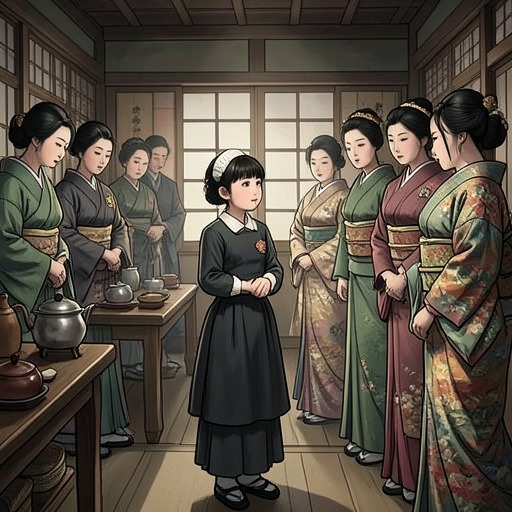
When Chiyo first meets her, Mother is introduced as Auntie’s younger sister, although neither woman was born into the same family as the other: Granny adopted them both, and inside the okiya they address each other as “Mother” and “Auntie.” The titles thus describe household positions as much as kinship. Mother’s appearance makes a stark impression on the child, who sees her in a delicate yellow silk-gauze kimono patterned with leafy branches and an elaborate russet-and-brown obi threaded with gold. The elegance of the clothing contrasts sharply with the face above its collar, an early image of the distance between the okiya’s polished surfaces and the hard authority that operates within it.
That authority is made unmistakable in Mother’s first instructions to Chiyo. She warns that the girl must learn to behave or be beaten, explains that Granny administers punishment, and orders her to work hard, stay in the okiya unless given permission, and do as she is told. Geisha arts may begin after two or three months, Mother says, but she did not bring Chiyo there to serve as a maid; if the girl proves too troublesome, Mother will throw her out. The promise of training is therefore conditional from the outset, bound to obedience and usefulness.
Discipline and the Okiya’s Economy
Mother’s rules extend beyond Chiyo’s individual conduct to the hierarchy of the house. After Chiyo upsets Hatsumomo, Mother makes her repeat an apology in a proper Kyoto accent before explaining that everyone in the okiya is supposed to help Hatsumomo succeed as a geisha. Even Granny, despite appearing difficult, works to make Hatsumomo’s career easier. Mother invokes this labor as the standard Chiyo must meet and tells her not to upset Hatsumomo again, noting that Pumpkin manages to keep out of the older girl’s way. The lesson is not simply politeness: a junior’s behavior is judged by whether it supports the house’s most valuable performer.
Mother makes the financial structure behind that hierarchy explicit when Chiyo learns what debt means. Once she begins working as a geisha, she will have to repay the okiya for her expenses: meals, lessons, medical fees, and even the money spent to acquire her. Mother’s account books, in which she spends time writing figures, embody an arrangement where care and training are advanced as liabilities against a girl’s future earnings. Chiyo had wondered whether money had changed hands when she and Satsu were taken from home; she had not understood that she herself would be made responsible for paying the okiya back.
The system also governs the okiya’s choice of an older sister for Chiyo. Mother tells Mameha that Pumpkin seems the safer investment because Chiyo’s debts are likely to grow under the guidance of a senior geisha whose fees are high. Yet Mother does not simply reject Mameha. She proposes that the okiya pay only half the customary share of Chiyo’s future earnings at first, then make up the difference, with an additional thirty percent, if Chiyo repays her debts by twenty as Mameha predicts. The bargain turns a training relationship into a long-term calculation: Mother risks a reduced immediate return in exchange for a larger one if Mameha’s confidence proves justified.
Adoption and the Transfer of Earnings
Mother’s most consequential financial decision follows Sayuri’s mizuage. The fee is sufficient to clear the debts Sayuri owes the okiya, but Mother adopts her the following week. By making Sayuri the okiya’s daughter, Mother ensures that the money does not pass into the young woman’s hands: the okiya absorbs her debts, while all of her profits thereafter belong to the house. Sayuri’s name changes from Sakamoto Chiyo to Nitta Sayuri, marking a change in legal and household identity that accompanies the transfer of economic control. Adoption is presented not as release from obligation but as a means of consolidating the okiya’s claim over the successful geisha.
The material objects that pass through the house clarify the scale of the economy Mother manages. The okiya’s kimono storehouse contains rows of lacquered cases and garments of immense value; the collection is described as worth roughly twice the villages of Yoroido and Senzuru combined, while its costliest apprentice robes are kept elsewhere in a rented vault. Such clothing is both artistic craft and capital tied to professional status. Mother’s attention to future earnings and the care of valuable garments belong to the same practical world, where a geisha’s appearance carries substantial costs and financial stakes.
Patronage, War, and Profit
When General Tottori becomes Sayuri’s danna, Mother’s calculations benefit from his position as director of military procurement. He covers expenses including lessons, registration, and medical costs, while his influence produces practical aid unavailable from an ordinary patron: when Auntie falls ill in March 1939, a doctor from the military hospital in Kamigyo Ward visits after a telephone call to the General and supplies medicine that cures her. The General also sends tea, sugar, and chocolates, commodities becoming scarce even in Gion. His patronage may not bring Sayuri the lavish gifts or leisure she had expected, but it materially supports the household and serves Mother’s interests.
During the war, Mother turns scarcity into another field of profit. She enters the gray market, buying and selling other people’s heirlooms and growing richer while others grow poorer. When Mr. Arashino sells a kimono to raise cash, Sayuri contacts Mother in the hope that she will recover it and hold it until he can afford to buy it back. Many Kyoto kimono pass through Mother’s hands, but she repeatedly claims she cannot find the pieces again. The objects that once signified a geisha’s livelihood and status become distressed assets in wartime, and Mother’s control of their circulation gives her a means to profit from the hardship that forces their sale.
Character and Narrative Significance
Mother’s decisions connect domestic authority to economic power. She can insist that Chiyo obey, require her to support Hatsumomo, and present apprenticeship as a privilege, while the household’s accounts convert food, instruction, illness, and acquisition into debt. Later, she uses negotiation, adoption, patronage, and wartime trade to secure income and resources for the okiya. These practices reveal the okiya as both a family structure and a business: its language of sisters and daughters coexists with calculations over costs, fees, and returns.
The novel’s recurring clothing and personal objects sharpen this portrait. An obi requires cords, clasps, and padding to make a costly garment sit smoothly; the kimono collection represents accumulated wealth; and, in wartime, a single robe may have to be sold to feed a household. Mother’s power lies not only in issuing orders but also in controlling the material and financial channels through which geisha life is sustained. The same house that promises Chiyo a possible path into the arts also makes her future earnings answerable to its ledger.